“Language”, “Thought”, “Emotion”
Few stop to wonder the workings of all these processes while going about daily life. One might’ve been told by parents growing up, as did I, “the world is very complex that it is mind boggling”. It brought about amazement and “curiosity” – a fourth word of this blog’s focus – towards how mind-boggling it could be. But underneath the inspiring perspective, it is also a communication of the inability for us to truly comprehend, and thus imply that it would be futile to pursue such frontiers of discovery… except perhaps for those whose logic is subdued by their curiosity.
A first dissection of the power of Language – the spoken and written form
Spoken language (including dialects) are verbal enunciations that on the outset carries meaning – those that had been impressed upon us as we grew up. But a child growing up could hear the words “WHAT!!” without interpretation, but associate tonality and physical threat or aggression with the given “word” placeholder as being “Angry”. Thus such a complex display of information is concisely impressed to be remembered as one word – which captures it all. But along with that, is the state of the one who learnt it. The child who feels the threat stores that very emotion in tandem with the intonation and the word. A programming of sorts happens within the mind and body – mind fears the idea of anger and body cowers in helplessness.
The above is an illustration of only one of many possible variations in the gamut of learning the spoken language. This possibility opens up with the natural progress in age and powers assumed or acquired in this course. For example, an adult may respond to the idea of anger not in fear, but in retaliation. Another, perhaps a monk, responds to it by detachment. A yogi by dissolution.
But as children, the enforced power structure is that of submission to the higher, and thus in this way programmatically learns through submission, acceptance, receptivity.
If we were to attempt to consider all these instances of learning through exchanges in the spoken word, it fact, they point strongly towards the learning of voice intonation, pace, physical posture, facial expression, in order to navigate to a more favourable outcome – which when young, is the avoidance of pain and the gain of pleasure.
Without derailing from the discussion, let me put forth here that in this respect, an physical adult may still be carrying on this programming through to his years even to old age.
If the above elaborations make any sense, then consider an individual who has the ability to escape the programmings from young – that is the inherent search of pain or avoidance of pleasure whenever a communicative exchange happens. This is the start of a truly critical mind – one who is able to interpret messages from the vantage point of an individual, or greater societal abstractions. However, an individual who could be critical behind pen and paper may not necessarily be able to stay that way between a real-time communicative exchange.
The second component of an exchange is the other person. The spoken language wrapped around tonality has the ability to shift mental patterns as the sublingual messages assert or imply threat or favour. An individual free from his own programmings is still very much susceptible – in fact even more susceptible – to the impressions of the world. For in a void of impressions is where it is most receptive to new ones. An individual capable of immunizing oneself against the tonal influences is then able to arrive at a holistic understanding of state of events. This is the state of detachment that we often hear about in modern day as “professional distance”, or in ancient religious teachings as “non-attachment”, which could extend beyond words into thought and action.
Next, consider the same individual who has developed the subtler awareness on the influence of tonality (“sounds”) on his mind and body. While the mental immunity can be achieved with specific energetic practices or preparedness – or even by counter-influencing the other to prevent their “attack” – at a fundamental level tonality has power both to the speaker and to the receiver. Sound, as a received vibratory energy is interpreted spontaneously and often has the effect of nervous mimicry when it is positive, and the effect of nervous revolt when it is negative. These are general observations but it is subjective to individuals by their own programmed nervous response.
I bring to reference ancient scriptures of the Veda. In Vedantic sanskrit, the tonality plays a unique role in impressing physiological-meaning through tonal quality, combined with thought-idea-meaning to become a scripture that is effecting to its reader intellectually as well as organically. The same concept applies across all languages and dialects, sounds by itself project qualities of love, kindness, sincerity, faith, forgiving, urging on one spectrum, or anger, hatred, envy on the other end.
One may find a unique quality in enlightened beings, in their highest states of consciousness will present a different voice quality as they strive not to influence the physical state of the audience into excitement, but into receptivity – yet not fully hypnotized – to create the opportunity for them to accept a new possibility, and arrive into it themselves, completing the formation of “knowledge of the message” as truth.
There are several basic tones or pitches that will serve an interesting discussion into the psycho-physical influences (more on this in another chapter)
But enough of my opinions. Why don’t we play some music or songs and see if it strikes a chord with you. Here are two of my favourites.
1) Ho’oponopono
The song is sung with warmth, embrace, forgiveness and love.
One can notice the different qualities of the voice which is in slow non-intrusive approach, yet with an energetic quality.
2) Ong Namo by Snatam Kaur
Next, I present to you the vocal qualities of those whose being is centered in the “greater harmony”, which is about preserving and radiating truth, and love.
1) Eckhart Tolle – Master of Presence
Up to this point, the above has been illustrative mostly of the expression of voice and the exchange of it between people. But these external expressions are mere transcriptions of an “inner voice”. This “inner (mental) voice” is more often than not occupied with the present affairs of the external world which is practical and often repetitive. Memory connected with mental thought patterns come together as mental conjurations that are meant to be effective (and sometimes destructive) for the external play.
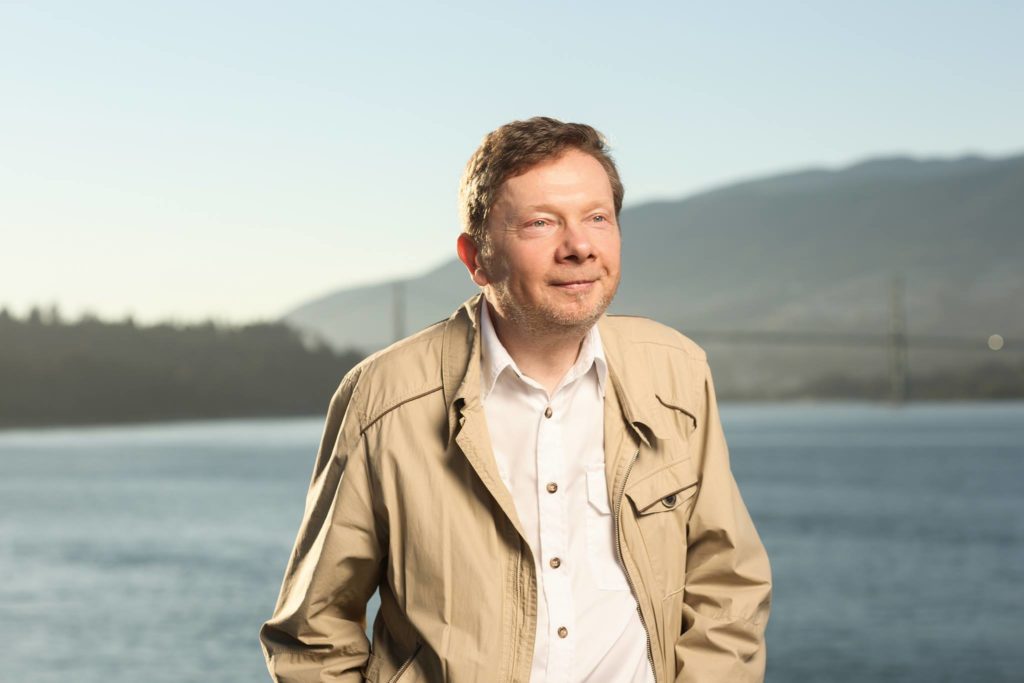
But in a minority of individuals who seek a deeper truth beyond face value (or rather, who innately have an urging to resolve the lack of completeness in an idea), who desires growth that comes from spiritual ardour, and who have come to appreciate a fuller beauty of reality – they await an inner (higher) voice. In such individuals are often found creative works which are exploratory in nature and syntheses a new expression or understanding of life.
(share analogy of the higher consciousness needing to speak in exact words in order to reach the mind)
2) Sri Aurobindo – the Adventure of Consciousness
There is much to be said about Sri Aurobindo that exhausts my capacity to illustrate here. An enlightened yogi of the previous century, a poet, and writer. There came a time when Sri Aurobindo retreated into complete solitude for 30 years and in that time produced his greatest epic Savitri.
The works are a transcription of greater ideas of reality into the written word and carry with it a power equivalent or greater than the spoken word. For in silence, the reading of words and exploration of ideas (theses) give rise to the opportunity to synthesize one’s truth-experience. It is said that students of Sri Aurobindo’s work – Integral Yoga – will first see the development of poetic expression. It is aptly put, that the works are a Silent Voice that to each reader, assists in his own journey forward.
Sri Aurobindo:
“I do not know what to say on the subject you propose to me – the superiority of music to poetry – for my appreciation of music is bodiless and inexpressible, while about poetry I can write at ease with an expert knowledge. But is it necessary to fix a scale of greatness between two fine arts when each has its own greatness and can touch in its own way the extremes of aesthetic Ananda? Music, no doubt, goes nearest to the infinite and to the essence of things because it relies wholly on the ethereal vehicle, sabda, (architecture by the way can do something of the same kind at the other extreme even in its imprisonment in mass); but painting and sculpture have their revenge by liberating visible form into ecstasy, while poetry though it cannot do with the sound what music does, yet can make a many-stringed harmony, a sound revelation winging the creation by the word and setting afloat vivid suggestions of form and color, – that gives it in a very subtle kind the power of all the arts. Who shall decide between such claims or be a judge between these god-heads?”
The Mother:
“There is a domain far above the mind which we could call the world of Harmony and, if you can reach there, you will find the root of all harmony that has been manifested in whatever form upon earth. For instance, there is a certain line of music, consisting of a few supreme notes, that was behind the productions of two artists who came one after another – one a concerto of Bach, another a concerto of Beethoven. The two are not alike on paper and differ to the but in their essence they are the same. One and the same vibration of consciousness, one wave of significant harmony touched both these artists. Beethoven caught a larger part, but in him it was more mixed with the inventions and interpolations of his mind; Bach received less, but what he seized of it was purer. The vibration was that of victorious emergence of consciousness, consciousness tearing itself out of unconsciousness in a triumphant uprising and birth.
If by Yoga you are capable of reaching this source of all art, then you are master, if you will, of all the arts. “
As a conclusion to this section, I would like to draw your attention to the qualities of the spoken word. Because sound has such a strong effect on the body’s nervous system (physically as vibration waves, and aurally as perceived sound), it has the ability to convey message, influence emotional state, and create pathways to consciousness.
Written language – symbolic forms are a memory system that serve to record words from within, and to preserve it. Beyond it, this preserved idea can be transacted with others as an exchange or learning process.
There are generally two kinds of readers and writers. We could test this to see for ourselves. When we read sentences, do we mouth it as if we were speaking it? Do we hear it in our head? Does it make no sense at all sometimes, as we re-read the sentence? Or does it flow seamlessly devoid of sound or speech, and with perfect receptivity?
The visual-symbolic form generally has less grips on the physical body and nervous system because it can be imparted by line of sight, vision, which is a highly interpreted faculty.
Unlike the spoken form, which requires our participation in “moving time” in order to capture a full sentence of meaning – and that that requires the mind to shift into a state of suggestibility or receptivity – the visual-symbolic form does not intrude directly into one’s nervous system as long as interpretation had not begun.
An exception to the above is when the vision arrives not by an external line of sight, but a pure conjuration-visualization from within. The degree to which the conjuration connects with the other sensory faculties will determine the depth of experience… and individuals who enter deep states of visualization (whether self-directed, guided, or spontaneous) would argue that it would be even more real than in the regular world. Confusion can arise when these faculties are no longer coherently sustained by the orchestrator of consciousness in the body. These internal visualizations have the ability to create effects on the body (positively or negatively) at a rate and magnitude greater than the visuals received from the external world.
So to put both systems in place, the combined ability of spoken form with the written form allows the transmission of sound qualities through silent reading.
A unique feature of language is in its ability to extend words into related ideas or higher forms of abstraction. What’s interesting is in the formation of these rules, such as grammar for English. Each of these “rules” could have a built in understanding of tonal qualities that allow the effective use of it in transposing a Root Word into other forms, that when spoken as intended delivers the physiological meaning to ellicit cooperation, receptivity and acceptance. As civilization that grew to add words into popular vocabulary, the tonal qualities were mostly positive despite a negative meaning to the word. It is only in the recent century that we have seen a distortion of tonal qualities of words originally created in positive, to imply and impress the negative meaning. For example, saying the word “provoke” as a word alone has no capacity to incite a provoked state of being. But a already provoked individual may speak the word in a provoked manner which transmits the meaning and the tonal quality to create a more impactful impression on the receiver. At the turn of the century, well-mannered speech had been slowly replaced by passion-speech.
… to be continued.
Leave a Reply