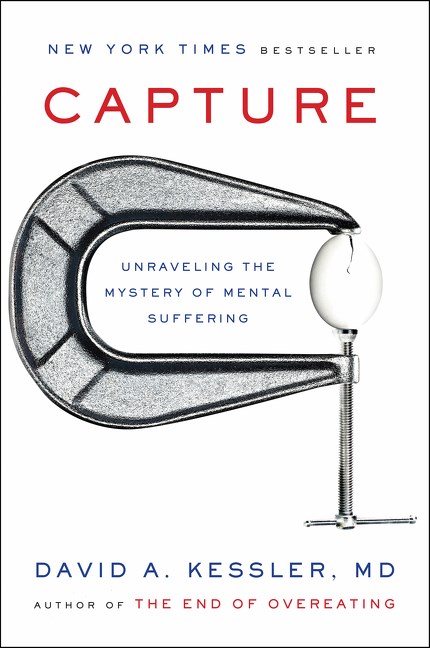
In the book titled “Capture” by David A. Kessler, it was mentioned that the Socratic doctrine posits that nobody willingly does what he or she regards as irrational.
“Socrates would say, if a person goes on taking drugs, for example, then the person is ignorant. The person really doesn’t think that the thing to do is to stop. Or if the person isn’t ignorant but keeps on doing it, it must be involuntary, there must be something forcing the person to do it.”
The Socratic doctrine asserts that one always participates in a conscious decision before taking any action. That is to say, the characteristic of normal “human” behaviour is to be discerning at all times. The Socratic doctrine thus places the idea of an ideal man, and further ties the concept of “human” to a state of perfection in rationalization. Those who are not rationally discerning are then assumed to be ignorant or to have been coerced into the act – as a justification, or excuse in order to satisfy the perfectionism in the concept of “human”. The direct consequence of this position causes humanity to indeed strive towards the perfect state of rationalization, and in the process discover the associated “ailments” that hinders it, and possibly even the “cures” for it.
One could argue that the position had value in projecting a perfectly desirable but extremely difficult state that each person could strive towards, and potentially realise, had they subscribed to that belief. It is akin to how one considers “God” to be the symbol of ultimate and unending virtue, and that each individual can partake in his own journey to come as close to that perfect idea of “God”.
There is another way to look at it.
If we first accept that rationalization is not what defines us as human, and we accept that it is only a differentiating trait, then it does not immediately impose on us to associate being human to being fully rational. Thus, the idea of “human” is now relaxed to a more organic and less abstract, less differentiated form. While less defined, it also gives greater flexibility to define ways in which a “human” can potentially be different from “others”.
This shifts the idea of “human” from one of fixed differentiated traits into one of potentialities.
In the days leading up to the modern era, there have been millions of reported cases of lost identities, trances, amnesia and various “personality disorders”. If an individual is capable of “feeling” that oneself is no longer the same person, then by definition, that person is still the same human being, but with a different “identity” or “persona”. In other words, what the individual had associated himself to be was but only an abstract idea, and has no bearing of whether he would be alive or dead the next day.
Here’s another viewpoint on how we have come to glorify the process of rationalization in making “correct” decisions, or in deriving “correct” thought.
Language evolved because there was a perceived benefit in doing so, for cooperation, for survival and for emotional sharing. Over time, language was refined into an art to improve the efficiency and accuracy of the communicated message, for an intended outcome. A process of rationalization was found to be useful in “predicting” future events in different time horizons. Rationalization could be used to predict events, behaviours, and eventually, it would be able to predict the next sentence or thought. And then, we started being able to “talk to ourselves”, to conjure theories and conjectures, and even share them with others. As each individual becomes increasingly more adept and more inquisitive, the collective found a use for discourse as a way to extract the deep hypothetical thoughts from various perspectives and to dissect through debate to find a unifying answer to the central theme of the discussion. Each individual hence walks away from the union having reaped the benefits of collective thought, as a greater refinement than what could have been from his own thinking process. Thus begins the widespread use of rationalization as a means of self-empowerment. The evolution of rational thought was indeed manifested by “agents” called humans, but it is in no way a complete picture of the capabilites or functioning of a “human”.
– inspired thoughts while reading “Capture” by David A. Kessler
Leave a Reply